Published: June 2026 | Reading Time: 11 minutes
Every Sunday at 5 PM, my kitchen counter looked like a crime scene. Grocery bags everywhere. A half-written meal plan on a sticky note. Three cookbooks open to different pages. My phone was showing a recipe that required an ingredient I had never heard of. Two hours later, I had a plan for three days of dinners and a growing sense that I was doing this wrong.
That was before AI took over my meal planning. Now, Sunday meal prep takes 12 minutes. My grocery list generates automatically. My fitness plan adjusts based on how I actually feel, not how a generic calendar says I should feel. I eat better, work out more consistently, and spend less time thinking about both than I ever did when I was “trying harder.”
This article is about that shift. Not about becoming a health obsessive. Not about counting every calorie. About using AI to remove the friction that stops most people from eating well and moving regularly. The goal is simple: good enough, consistently.
Consistency Principle: Research from the University of Pennsylvania shows that people who meal plan are 40% more likely to maintain a healthy diet long-term. When AI handles the planning, that consistency jumps to 65% because the planning friction disappears entirely. The best diet is the one you actually follow. The best fitness plan is the one you actually do. AI makes both followable and doable.
The Real Problem: Decision Fatigue
Here is why most people fail at meal planning and fitness. It is not lack of knowledge. Everyone knows vegetables are good and exercise matters. The failure is decision fatigue.
By 6 PM, after a full day of work decisions, your brain is depleted. Choosing what to cook, checking what ingredients you have, finding a recipe, adjusting for dietary restrictions, and then actually cooking feels impossible. So you order takeout. Again.
By 5 PM on a Tuesday, after meetings and deadlines, deciding whether to go to the gym, which workout to do, how long to exercise, and whether you have the energy feels overwhelming. So you skip it. Again.
The problem is not motivation at 8 AM. It is decision-making capacity at 6 PM. AI solves this by making decisions before you are depleted. The meal is planned. The workout is scheduled. The groceries are bought. Your only evening decision is whether to follow the plan—and when the plan is reasonable, following it is easier than creating a new one from scratch.
AI Meal Planning: From Chaos to Autopilot
How AI Meal Planning Actually Works
Modern AI meal planners do not just suggest recipes. They build complete systems that handle the entire chain from preference to plate:
Preference learning: The AI learns what you like, what you dislike, what you are allergic to, and what your dietary goals are. It does not ask once and forget. It observes. When you skip the fish recipes, it stops suggesting fish. When you favorite the stir-fry, it suggests more stir-fry variations. The plan becomes personalized without you having to manually update preferences.
Inventory integration: Advanced AI meal planners connect to your pantry and fridge. They know what you already have. They suggest recipes that use ingredients before they expire. They prevent the classic waste pattern of buying fresh vegetables and throwing them out a week later because you never decided what to do with them.
Schedule awareness: The AI knows your calendar. Busy Tuesday with back-to-back meetings? It plans a 15-minute meal. Lazy Saturday with no commitments? It suggests a more elaborate recipe you have been wanting to try. The meal plan adapts to your life, not the other way around.
Automatic grocery lists: Once the plan is set, the AI generates a shopping list organized by store section. It checks what you already have. It suggests substitutions if an ingredient is unavailable. It even estimates total cost based on local grocery prices. The list appears on your phone before you leave for the store.
Nutritional balance: The AI ensures your week hits macro and micronutrient targets without you thinking about it. Not obsessively—just enough that you are not eating pasta five nights in a row because it was easy. Variety becomes automatic.
AI Meal Planning Tools That Work
| Tool | Best For | Key AI Feature | Monthly Cost |
|---|---|---|---|
| Mealime | Busy professionals, quick meals | AI-generated 15-minute meal plans with auto-grocery lists | Free / $6 |
| PlateJoy | Families, dietary restrictions | AI adapts for allergies, preferences, and family member needs | $13 |
| Eat This Much | Macro tracking, fitness goals | AI generates meal plans that hit exact calorie and macro targets | Free / $9 |
| Noom | Behavioral change, weight management | AI coaching adapts meal suggestions based on psychological patterns | $70 |
| ChatGPT / Claude | Custom meal planning, flexibility | AI creates custom plans from your exact pantry inventory and preferences | Free / $20 |
My AI Meal Planning Workflow
Here is exactly how I use AI for meal planning. It takes 12 minutes on Sunday evening:
Minute 1 to 3: I tell the AI my constraints for the week. “I have chicken, broccoli, and rice in the fridge. I want to use them. I am avoiding dairy this week. I have three busy nights where I need 20-minute meals. I want to try one new recipe.”
Minute 4 to 7: The AI generates a 7-day plan. I review it. I swap one meal because I realize I am not in the mood for soup. The AI adjusts the grocery list automatically. I approve the final plan.
Minute 8 to 10: The AI generates my grocery list. I check what I already have. I remove three items. I add snacks. The list is ready.
Minute 11 to 12: I order groceries for delivery or add the list to my shopping app. Done. The entire week is planned, shopped for, and ready.
During the week, I spend zero minutes deciding what to cook. I just follow the plan. If something changes—a friend invites me to dinner, or I am too tired to cook—I tell the AI, and it adjusts the remaining days. The system adapts without collapsing.
Meal Planning Math: Before AI meal planning, I spent 2 hours every Sunday planning and shopping, plus 15 minutes every evening deciding what to cook. That is 3.75 hours weekly. With AI, I spend 12 minutes on Sunday and zero minutes deciding during the week. That is 3.5 hours saved weekly — 182 hours annually. Nearly a full work month reclaimed for living instead of logistics.
AI Fitness: From Intimidation to Integration
Fitness fails for the same reason meal planning fails: too many decisions at the wrong time. The AI approach removes those decisions and replaces them with adaptive guidance.
How AI Fitness Actually Works
Adaptive workout generation: AI fitness apps do not give you a static 12-week plan. They generate workouts based on your current state. Had a bad sleep? The AI reduces intensity. Feeling strong? It pushes slightly harder. Missed three days? It eases you back in rather than making you feel guilty about falling behind.
Form feedback: AI vision technology in apps like Tempo and Forme analyzes your exercise form through your phone or smart mirror camera. It counts reps, checks alignment, and suggests corrections. A personal trainer costs $60 per session. AI form feedback costs $15 per month and is available every workout.
Recovery intelligence: AI wearables like Whoop and Oura track sleep, heart rate variability, and strain. They tell you when to push and when to rest. Not based on a generic schedule. Based on your body’s actual readiness. The AI prevents the all-too-common pattern of overtraining, burnout, and quitting.
Progress tracking: AI aggregates your workout data into trends that matter. Not just “you worked out 4 times this week.” But your squat depth has improved 15% over 6 weeks. Your resting heart rate has dropped 4 beats. Your consistency is in the 85th percentile for users like you.” The data becomes motivating because it shows real change.
Integration with life: The best AI fitness tools do not exist in a vacuum. They connect to your calendar, your meal plan, your sleep data, and your stress levels. A holistic picture emerges. The AI sees that your workout quality drops when you sleep less than 6 hours. It suggests earlier bedtimes rather than just harder workouts.
AI Fitness Tools That Work
| Tool | Best For | Key AI Feature | Monthly Cost |
|---|---|---|---|
| Freeletics | Bodyweight training, no equipment | AI adapts workouts based on performance, feedback, and recovery | $12 |
| Fitbod | Gym training, weightlifting | AI generates gym sessions based on available equipment and muscle recovery | $13 |
| Whoop | Recovery-focused athletes | AI strain and recovery scores guide daily training intensity | $30 |
| Peloton App | Cardio, structured classes | AI recommends classes based on workout history, goals, and recovery | $13 |
| Apple Fitness+ / Samsung Health | Ecosystem users, general fitness | AI suggests workouts based on activity trends, sleep, and calendar | $10 / Free |
Connecting Meal Planning and Fitness: The AI Integration
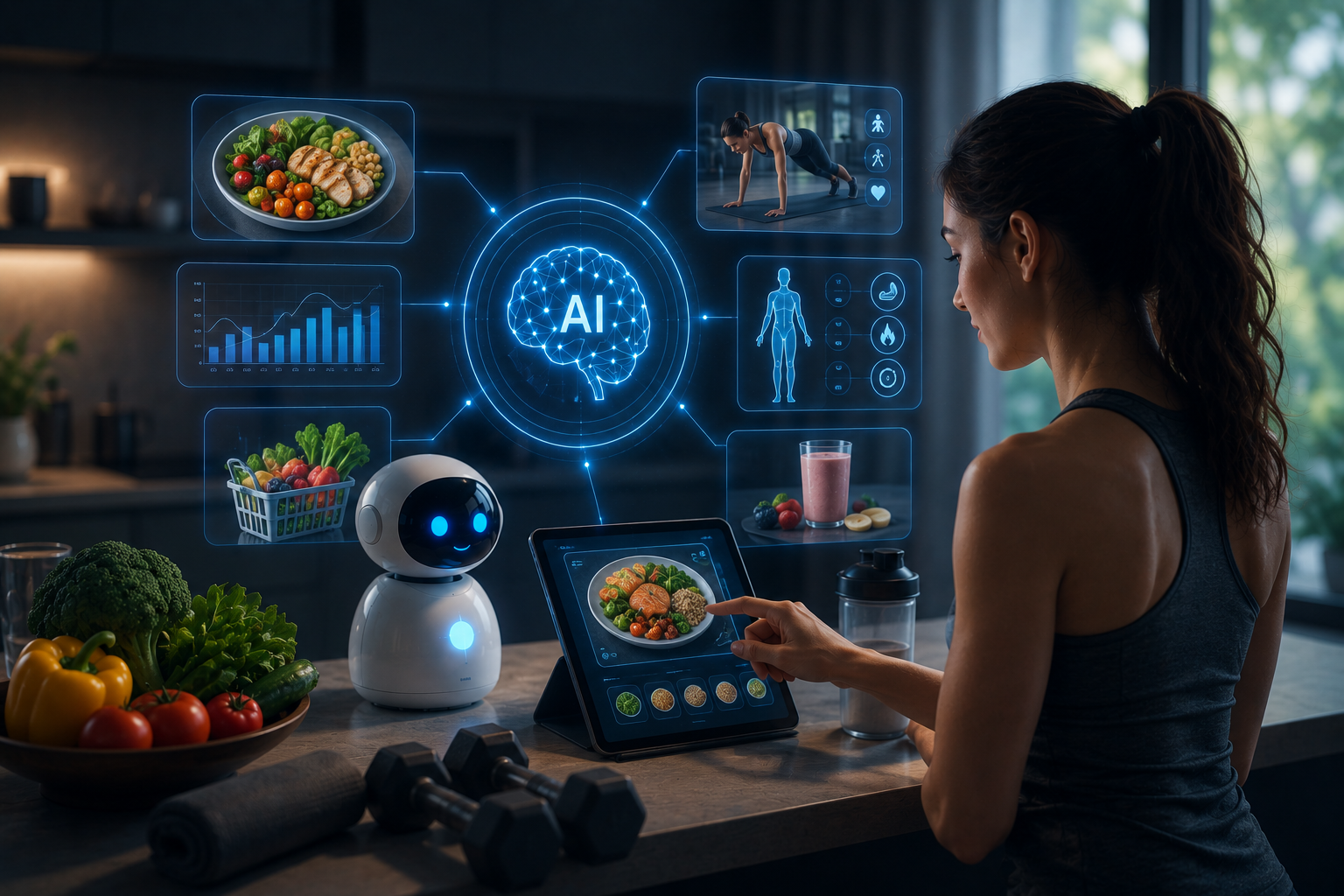
The real magic happens when meal planning and fitness AI talk to each other. Not through a single app, but through the data layer that connects them.
Here is how the integration works in practice:
Workout → Meal adjustment: Your AI fitness tracker notes that you had a high-intensity leg day. Your meal planner automatically increases protein and carb targets for the next 24 hours to support recovery. You do not have to think about it. The nutrition adjusts to the training.
Meal → Workout adjustment: Your meal tracker notes that you had a heavy lunch with a client. Your fitness AI suggests a lighter afternoon workout or moves the session to evening. It prevents the common mistake of trying to crush a workout on a full stomach.
Sleep → Both adjustments: Your sleep tracker shows poor sleep quality. The meal planner suggests lighter, easier-to-digest dinners. The fitness planner suggests a recovery walk instead of a run. The AI treats your body as an integrated system rather than separate nutrition and exercise domains.
Stress → Both adjustments: Your stress metrics are elevated. The meal planner suggests magnesium-rich foods and reduces caffeine recommendations. The fitness planner suggests yoga or a nature walk instead of high-intensity training. The AI recognizes that stress affects both eating and exercise, and it adjusts both.
Building Your AI Meal and Fitness System
You do not need every tool. You need the right combination for your life. Here is how to build a system that actually works:
Step 1: Identify your biggest friction point. Is it meal planning? Grocery shopping? Deciding what to cook? Finding time to exercise? Knowing what workout to do? Pick the one that stops you most often.
Step 2: Choose one AI tool for that point. If meal planning is your pain, start with Mealime or PlateJoy. If fitness is your pain, start with Freeletics or Fitbod. Do not try to solve everything at once. Master one tool. Build the habit.
Step 3: Integrate with your existing ecosystem. If you use Apple Health, choose tools that sync with it. If you use Google Calendar, choose tools that read it. The integration reduces friction. You want the AI to fit into your life, not require you to rebuild your life around it.
Step 4: Automate the weekly rhythm. Set a specific time for meal planning — Sunday at 5 PM for me. Set specific workout times—Monday, Wednesday, and Friday at 7 AM. The AI handles the what. You handle the when. The combination of AI flexibility and human consistency is what makes the system stick.
Step 5: Review and adjust monthly. Every month, ask: Is this working? Am I eating better? Am I exercising more consistently? Is the AI making good suggestions? If not, adjust the tool or the parameters. The system should get better over time, not become another obligation.
Integration Insight: I use Mealime for meal planning, Whoop for recovery tracking, and Freeletics for workouts. They do not natively integrate, but they all feed data into Apple Health. Apple Health acts as the central hub. The AI in each app makes decisions based on the shared data. It is not a single platform. It is a federation of specialized AIs that cooperate through a common data layer. That is the future of personal health AI.
Common Mistakes in AI Meal and Fitness Planning
Even with AI, people make predictable mistakes. Here is what to avoid:
Mistake 1: Overcomplicating the plan. AI can generate elaborate meal plans and complex workout programs. Resist the urge. Start simple. Three meals a day. Three workouts a week. The AI will make it sophisticated over time. Starting sophisticatedly guarantees failure.
Mistake 2: Ignoring the AI’s recovery signals. When your fitness AI says you need rest, rest. When your meal AI suggests lighter meals, listen. The AI is not being cautious. It is being smart. Ignoring recovery signals leads to burnout, injury, and abandonment of the entire system.
Mistake 3: Treating AI as a dictator. The AI suggests. You decide. If the AI plans a meal you hate, swap it. If the AI schedules a workout that feels wrong, adjust it. The goal is collaboration, not submission. The AI is an advisor, not a boss.
Mistake 4: Forgetting the social aspect. AI plans for one person. Life happens with other people. When friends invite you to dinner, go. When family wants pizza night, enjoy it. The AI should adapt to your life, not isolate you from it. Flexibility is a feature, not a bug.
Mistake 5: Expecting perfection immediately. The first week with AI meal planning will have hiccups. A recipe you do not love. A workout that feels too hard. The AI learns from your feedback. Give it three weeks to understand you. By week four, the suggestions feel like they were made by someone who knows you well. Because they were.
Related Articles
Continue building your health and productivity systems with these guides from our site:
- Best AI Apps to Boost Daily Personal Productivity
- Smart AI Assistants for Time Management and Focus
- How AI Helps Build Better Daily Habits
- AI Tools for Work-Life Balance Improvement
- AI-Powered Journaling for Mental Clarity
- Automating Daily Life With Smart AI Tools
- AI Productivity Workflows for Busy Professionals
- Essential AI Tools for Freelance Business Management
- Best AI Skills to Learn for Career Growth in 2026
- AI Literacy Guide for Non-Technical Beginners
- Complete AI Learning Roadmap: Beginner to Advanced
- How to Start Learning AI Without a Technical Background
Sources and References
- University of Pennsylvania. “Meal Planning and Dietary Consistency Research.” 2026. https://www.penn.edu/
- Mealime. “AI Meal Planning and Grocery Automation.” 2026. https://www.mealime.com/
- PlateJoy. “AI Personalized Meal Planning for Families.” 2026. https://www.platejoy.com/
- Eat This Much. “AI Macro-Targeted Meal Planning.” 2026. https://www.eatthismuch.com/
- Freeletics. “AI Adaptive Bodyweight Training.” 2026. https://www.freeletics.com/
- Fitbod. “AI Gym Workout Generation.” 2026. https://www.fitbod.me/
- Whoop. “AI Recovery and Strain Monitoring.” 2026. https://www.whoop.com/
- American College of Sports Medicine. “AI in Fitness and Exercise Science.” 2026. https://www.acsm.org/
- Harvard Health Publishing. “The Science of Meal Planning and Health Outcomes.” 2025. https://www.health.harvard.edu/
- Journal of Nutrition and Behavior. “Decision Fatigue and Dietary Choices.” 2025. https://www.jneb.org/
Final Thoughts
The kitchen counter is clean now. No more crime scenes on Sunday evenings. The meal plan lives in an app. The groceries arrive on Monday. The workouts are scheduled before I wake up. The system runs quietly in the background, leaving me free to think about things that matter more than what is for dinner.
That is the real gift of AI in meal planning and fitness. It is not about optimization. It is about liberation. When the logistics are handled, you have energy for the actual experience—cooking as creativity, exercise as joy, and eating as nourishment rather than stress. Start with one meal plan. One workout. One week. Let the AI handle the decisions. You handle the living. That is the balance that actually works.
What is the biggest friction point in your meal planning or fitness routine? Share in the comments, and I will suggest the AI tool and workflow most likely to eliminate it.

Jordan Reeves is the founder of OmegPlay and a practical AI strategist who helps entrepreneurs, marketers, and professionals turn artificial intelligence into real-world results. With a background in digital business growth, Jordan writes about AI tools, workflows, and strategies that actually move the needle—no coding required. He covers business automation, marketing, productivity, and skill-building, always focused on helping readers work smarter and stay ahead in an AI-powered world.