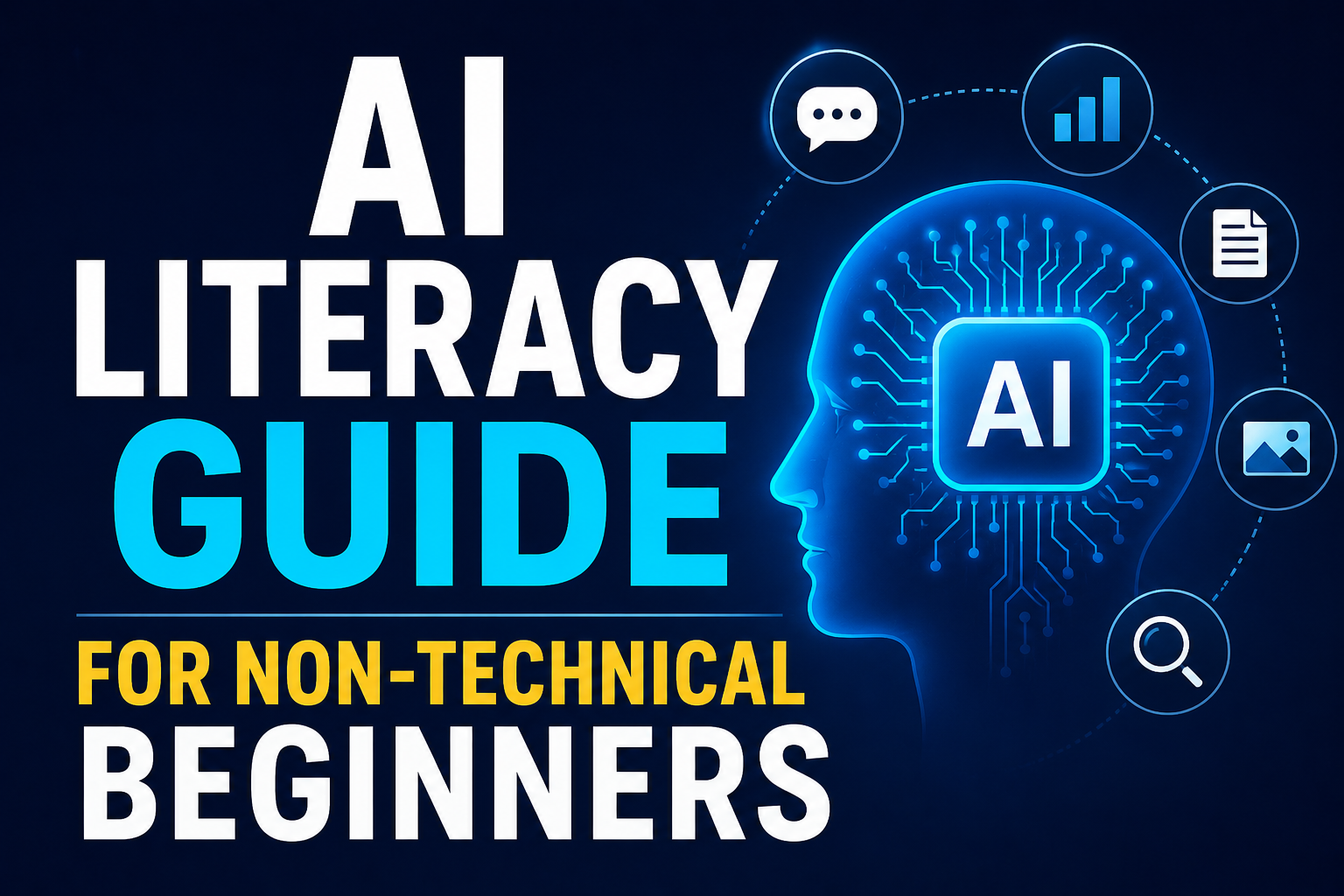
We are seeing the rapid transition of artificial intelligence (AI) from the lab to our daily lives. Automated email completion, fraud warnings from financial institutions, sickness prognosis (even before symptoms appear), and Netflix series recommendations are just a few of its impressive capabilities. The problem is that the majority of system users have no idea what these systems are or how they function.
It is vital to fill this knowledge gap. If you don’t know how AI works, you won’t know when to trust it, when to doubt it, or how to maximize its benefits. You need not pursue a career in programming or data science to acquire AI literacy. When artificial intelligence (AI) decides what you see, hear, buy, and believe in the future, it means you have enough knowledge to make educated decisions. Anybody interested in learning more about AI can benefit from this tutorial since it explains the basics without using too much technical language. After finishing the course, you will have a far better grasp of artificial intelligence (AI), its implications for your daily life, and the best ways to navigate it.
Basic Principles of AI
Artificial intelligence refers to computer systems capable of performing tasks that normally require human intelligence. These activities include speech recognition, language translation, generating suggestions, and discovering patterns in data. The concept of artificial intelligence (AI) was introduced in 1956, but the technology has made significant progress over the past ten years.
Machine learning forms the core of most AI today. Machine learning systems learn from data rather than following pre-written rules. For example, feed a machine millions of cat photos and it can learn to recognize cats; feed it years of medical records, and it can identify risk factors for diseases. This is why AI continues to improve over time. The more data a system has, the better its performance becomes.
Deep learning, a branch of machine learning, uses multilayer networks that roughly mimic the human brain. Deep learning enables applications such as facial recognition, real-time translation, and chatbots. warning. You don’t need to understand the technical aspects of deep learning, but insight into its existence helps explain why today’s AI can achieve things that were unthinkable just a few years ago.
Exploring the Practical Applications of AI
AI now integrates into various technologies we use daily, often without our knowing it. Streaming services like Netflix and Spotify use AI to analyze your viewing and listening habits and recommend content you might be interested in. Google Maps uses AI to predict real-time traffic information. Email programs also use artificial intelligence (AI) to filter spam and recommend responses.
In healthcare, professionals rely on AI systems to assess medical images with an accuracy comparable to human assessments. In the banking sector, AI can identify unusual transaction patterns, thereby preventing losses due to fraud. In retail, AI enables personalized product recommendations and dynamic pricing.
Understanding these applications is not about admiring the technology but about recognizing the impact AI is already having on your daily life. Understanding how AI works helps you better understand how these decisions are made.
The Challenges of AI Ethics and Bias
The performance of AI systems depends largely on the quality of their training data; however, this data reflects the world as it is, not an ideal world. This gives rise to bias. If a recruitment algorithm is trained with data that historically favored male candidates, it may also discriminate against women. This is not because someone programmed that logic into the software, but because the data itself contains this bias.
Facial recognition algorithms have a significantly higher error rate when identifying people with dark skin tones than others, a phenomenon that Joy Buolamwini of the MIT Media Lab has investigated. Predictive policing methods also receive much criticism because they exacerbate existing racial inequality in the criminal justice system. These are not merely theoretical risks but real consequences that affect daily life.
Ethical AI means that we must face these difficult questions: Who designed the system? What data was used for the training? Who benefits from it? Who can be harmed by it? Asking these questions does not require a computer science degree. In fact, those who understand AI technology and its social context are better able to develop AI talent.
Developing Critical Thinking about AI
Critical thinking about AI means evaluating AI output with the same skepticism you would approach any other source of knowledge. AI systems can generate text, images, and sounds that sound authoritative but are actually incorrect—a phenomenon known as ‘illusion.’ Articles written by AI may refer to research that does not exist. Images generated by AI may depict things that never happened.
The ability to investigate AI output is rapidly becoming just as important as media literacy. Verify AI-generated information against known sources. Look for identifiable authors, publication dates, and proof of source citation. Exercise extreme caution when AI is used for medical, legal, or financial advice, as incorrect information can have disastrous consequences. Healthy skepticism does not mean completely rejecting AI. It means viewing technology as a tool with real capabilities and limitations—useful when you understand it, harmful when you rely on it blindly.
Practical Steps for AI
Developing AI literacy does not require a university education or a strong mathematical foundation. There are many practical and easy-to-learn methods. Generative AI can be tested in low-risk environments using free tools such as Google Gemini, Microsoft Copilot, and even ChatGPT. Ask them questions and keep pushing their boundaries. Watch when they make mistakes.
Getting started: Platforms like Coursera, EdX, and Khan Academy offer free introductory courses on AI suitable for people without a technical background. Google’s “AI for Everyone” course is a good option, which requires no programming skills. For a broader understanding of the societal and policy implications, you can consult resources from organizations such as the AI Now Institute or the Partnership on AI. One of the most effective ways to develop true AI literacy is by making direct use of AI technologies, while simultaneously maintaining interest and skepticism. Practice makes perfect, not just books.
The Future of AI and Lifelong Learning
Artificial intelligence is not a finished product. It is a rapidly evolving field that will continue to revolutionize every aspect of work, communication, creativity, and government operations in the coming decades. New opportunities and new risks will constantly emerge. Although AI will lead to the loss of millions of jobs, the World Economic Forum points out that it will also create new types of jobs that do not yet exist.
Lifelong learning is the right answer to this reality. AI literacy is not a one-time event but a habit that requires maintaining interest, continuously updating knowledge, and adapting to the evolution of technology. Those best positioned to follow future trends are those who have a sufficient understanding of AI, can use it consciously, reflect critically on it when necessary, and steer its development toward greater human values.
Building a Better Relationship with AI
AI is not magic, and we do not need to be afraid of it. It is a powerful tool, designed by humans, developed based on data, and driven—or misled—by those who build and use it. The human mind is much wiser than simply copying AI’s output.
Start small. Choose an AI tool you already use and spend 20 minutes carefully studying how it works, the data it uses, and its limitations. But curiosity, combined with thorough study, is the foundation for truly mastering AI literacy.
FAQs
1. What is AI literacy? Why is it so important?
AI literacy refers to the ability to learn, critically understand, and apply AI technologies correctly. This is crucial because AI is used to make important decisions in sectors such as healthcare, banking, recruitment, and the criminal justice system—sectors that affect virtually everyone. People with weaker reading skills are less likely to question incorrect results or demand fair treatment.
2. Do I need to be able to program to be AI literate?
No. For non-technical beginners, AI literacy refers to conceptual understanding, critical thinking, and practical application, not programming. Other resources, such as Google’s “AI for Everyone” course, specifically target non-technical users.
3. How can I check whether the AI-generated output is correct?
Verify AI-generated results using reliable sources. Pay attention to authors, cited research, and publication dates. Be especially skeptical about AI-generated medical, legal, or financial information. Furthermore, be wary of unsubstantiated claims, regardless of how convinced the person making them is.
4. What is AI bias? Why does it affect ordinary people?
AI bias occurs when a system generates biased results due to flawed or non-representative training data. It can determine who gets hired, who receives a loan, what diagnosis you ultimately receive, and even who ends up in prison. According to the MIT Media Lab, facial recognition algorithms perform worse on people with darker skin tones, and this has practical implications.
5. How should AI beginners get started?
First, try using free AI tools like ChatGPT or Google Gemini to gain practical experience and understand the limitations of AI. Next, look for structured introductory courses on platforms like Coursera or edX. Organizations such as the AI Now Institute can help you stay up to date on ethical and societal developments surrounding AI.