
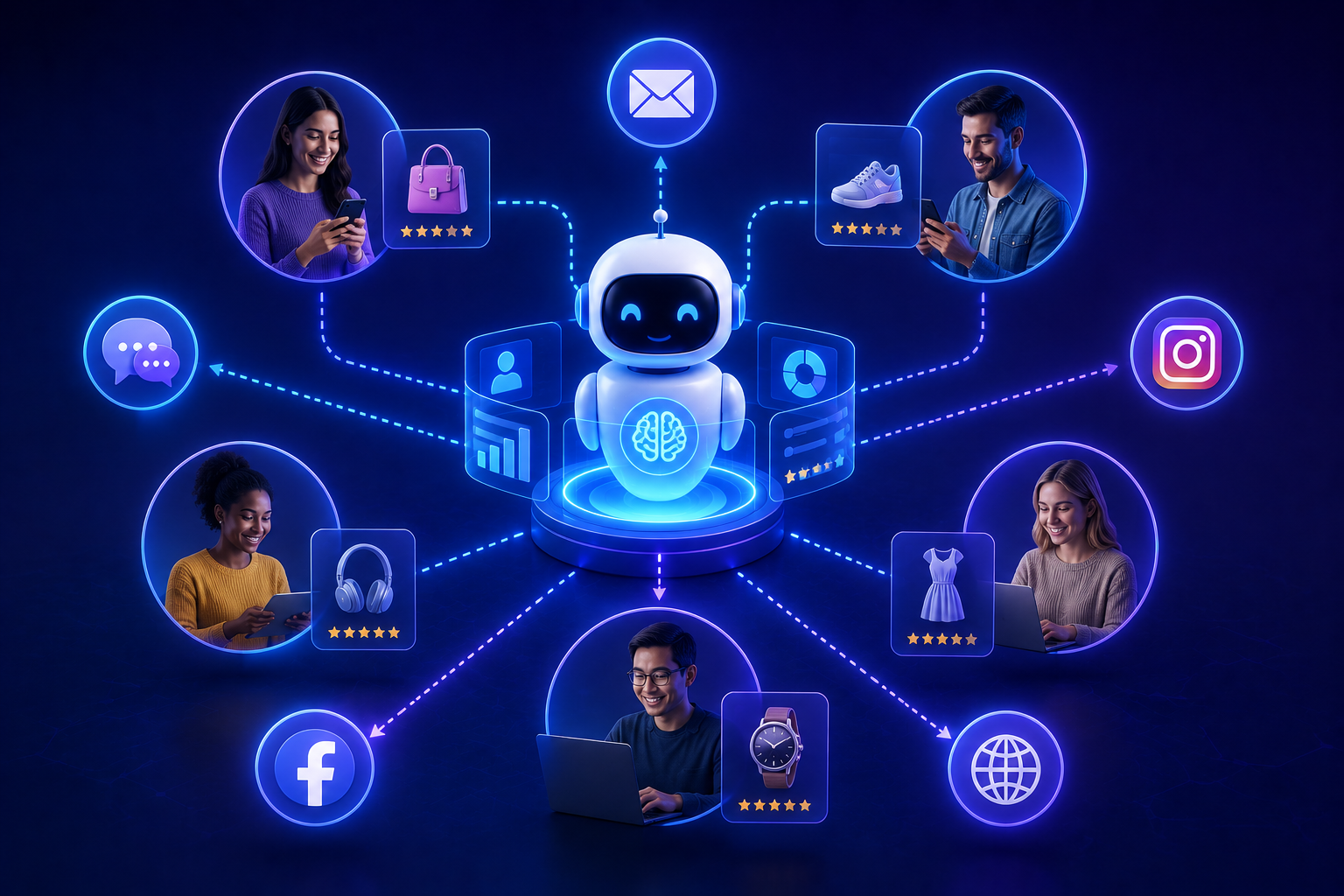
Compared to the previous twenty years, the change in marketing in the last few years has been far more significant. Companies used to think they could send the same message to everyone and that it would work. The demands of consumers today are very different. Individualized attention is what they seek. An enormous shift has occurred because of the proliferation of AI.
With the use of AI, businesses no longer have to speculate about what their customers want; instead, they can learn their real behavior, including the things people click on, ignore, search for, and even their peak activity times. An integral aspect of this paradigm change toward better user experience is technological advancements. Picture this: you enter a store, and the salesman already knows your tastes, your budget, and everything about your purchases. Artificial intelligence works toward this goal in the digital realm.
The most noticeable shift, in my opinion, is the growing recognition among SMB owners of the need for targeted, individualised advertising. This is the basis of contemporary advertising. AI enhances the effectiveness of product suggestions, social media marketing, and email marketing. Customers are more receptive and less likely to feel pressured when they see marketing information that is relevant to them.
A Situation in the Real World:
For example, let’s pretend a tiny online clothes business sends out the identical promotional email to 10,000 people. Even though half of the recipients reside in warmer regions, this email promoted winter apparel. Someone else had completely disregarded the email after purchasing a coat the previous week. Another set of people unsubscribed because they were out shopping for summer clothes. The simple fact that traditional marketing approaches all customers similarly is problematic. It pays no attention to the user’s environment, actions, or time. Despite investing money, companies don’t see much of a return.
Contrarily, AI-driven marketing operates in an entirely different manner. Artificial intelligence studies client actions before sending a cookie-cutter message. Using it, you can find people who love winter apparel, are watching their spending, and can afford premium items. It creates category-specific, tailored marketing content. This has practical applications in many fields; it is not merely theoretical. By moving away from a “one-size-fits-all” strategy and toward “precise targeting and precise reach,” even smaller e-commerce platforms have seen a marked improvement in their conversion rates. This change typically makes a huge impact because it clarifies the email’s substance for the customer.
A Clear Path for AI to Gain Insight into Consumer Behavior
AI in advertising is really straightforward. Imagine it as a smart assistant that can spot patterns. Despite its inability to “think” like a person, it outperforms humans in spotting data trends. Clicking on skincare products while shopping late at night is just one example of the patterns of behavior that artificial intelligence records. When consumers normally shop during sales, another trend becomes apparent. Observing these minute characteristics uncovers each customer’s behavior over time.
An integral part of this is AI-powered personalized marketing. By analyzing user behavior, the system can anticipate their needs and provide product recommendations, email alerts, and ad displays at the optimal time for conversion. One advantage AI has is its capacity to learn. The system is designed to adapt on its own if a consumer decides to purchase high-end items instead of inexpensive ones. Due to its ability to learn and adapt to changes in consumer behavior, AI marketing gives the impression of being natural and effective.
Get Your First AI-Powered Customer Segment Off the Ground
Customer segmentation is the first step in AI-driven marketing. Here, you’ll divide your potential customers into several groups according to their hobbies, actions, or past purchases. AI segmentation outperforms manual segmentation in terms of accuracy and dynamic nature. In place of age or location, AI can classify clients according to their objectives. Customers may fall into several categories, such as those who frequently peruse the store but never make a purchase, those who frequent the store often but only buy more expensive things, and those who shop primarily during sales or holidays.
After applying this method, a tiny business witnessed remarkable outcomes. Due to the personalized nature of the information they sent out, their email engagement rate almost doubled in just a short period of time. They weren’t handled like a bunch but as unique people. There is no need for manual updates with AI segmentation, which is a major advantage. Based on consumer actions, the system refreshes categories mechanically. Companies may now maintain accurate customer records without wasting time on manual data analysis or making educated guesses about their motivations.
Campaigns for Targeted Email and Text Message Advertising
Although email marketing is not new, AI has recently given it a significant boost. Instead of sending out mass emails, businesses can now send out personalized, one-on-one messages. An AI system may tailor the subject line of an email based on the customer’s interests. “New fitness items, designed especially for you.” is one possible email copy for a customer who often peruses fitness product listings. Something like, “Exclusive 20% discount on your favorite items.” would show up in a marketing campaign if another customer wanted a discount.
The content of an email can also be dynamically changed. Product descriptions, suggestions, and overall tone can be impacted by user actions. Big marketing groups used to spend days—if not weeks—making these customizations. This now takes only seconds for AI. Most obviously, there is the advantage of interaction. More people open and respond to emails that are relevant to them. Ads are starting to seem more like helpful recommendations to users. This nuanced change in mindset is the key to why AI-driven campaigns might enhance contemporary marketing strategies.
Implementing AI for Immediate Product Suggestions
One of the most important uses of AI in marketing is making product suggestions. Online buying suggestions like “Buy together often” or “You might also like this” are nothing new. Nonetheless, contemporary AI systems are substantially more robust. Users’ online activities can be monitored in real-time. If a consumer is searching for running shoes, for instance, AI can swiftly suggest other items like apparel, hydration packs, and socks. Over thousands of comparable clients, the system monitors patterns.
Time enhances the efficacy of real-time suggestions. At the exact moment that customers are most receptive to them, suggestions are displayed. This has the potential to boost conversions while people are still deliberating. The average order value can be increased by businesses that use AI-driven suggestions. When customers shop for more than one item, they may find complementary things that can be useful. Without resorting to pushy sales tactics, this enhances the buying experience and boosts income.
Enhancing Ad Effectiveness with the Use of AI Personalization
Artificial intelligence (AI) elevates the already-essential practice of precise audience targeting in advertising. Ads are tailored to each user’s unique tastes and habits using AI. The advertisements that appear to consumers can vary greatly, even when they search for identical information. In this case, one user could see cheap ads and the other high-quality content. Machine learning is able to deduce the individual goals of each user.
Ad delivery timing is optimized using AI. When user activity and engagement peaks, it can identify them. When it comes to delivering ads, timing is king. Consequently, less money is going to be squandered on ineffective advertising initiatives. Instead of aimlessly pursuing a large audience, businesses can precisely target customers who are ready to convert. This boosts return on investment and makes better use of marketing funds over time. Even more intriguing is the fact that AI can optimize marketing campaigns automatically. By enhancing targeting, the ad message, and delivery methods with more data, advertising can become smarter and more efficient, ultimately reducing or eliminating the need for human participation.
The Most Frequent Errors Regarding Artificial Intelligence in Marketing
Many businesses fail to grasp or abuse AI’s potential. Assuming you would see results immediately is a typical error. Data is still necessary for AI marketing technology to learn, despite its ongoing evolution. The over-automation of processes is another typical error. In an ideal world, no human intervention would be necessary at all, and that is the goal of several businesses. Mechanical or impersonal communication is possible. The credibility of automated communications is highly valued by customers.
Ignoring data quality is a third issue. Artificial intelligence will fail to provide useful insights if the supplied data is inaccurate or missing key information. Accurate, consistent data is essential for AI-powered tailored marketing. Companies that successfully integrate AI’s efficiency with human invention are the ones I’ve worked with. While AI excels at automating and analyzing, humans still define the brand’s strategy, tone, and personality. This synergy results in smart and pertinent advertising.
Formulating Your Personal Approach to Artificial Intelligence Marketing
You can learn AI marketing without breaking the bank or needing specialized gear. Learn your customers’ buying habits, interaction frequency, and indifference rates first. Choose an intuitive-to-understand AI-powered email marketing or consumer segmentation solution next. The requirement for programming or configuration is rendered unnecessary by many systems’ built-in AI features. Sending out tailored emails or suggesting products is a good place to start.
Gathering data to determine which approaches work is the first step. Which ones draw in more readers? In terms of clicks, which products perform best? When backed by actual user feedback, artificial intelligence performs at its peak. Predictive analytics and the ability to personalize in real-time will also be available to you in due course. An approach that is slow and methodical is essential. Fundamentally, AI marketing does a better job of enhancing creativity than replacing it. With proper implementation, it can aid businesses in comprehending their clients, enhancing communication, and establishing lasting alliances.
Conclusion
Businesses are transforming their consumer connections with AI tailored marketing efforts. Now businesses can scale up the delivery of personalized, timely, and engaging experiences rather than impersonal, generic messaging. With the use of AI, companies can better understand consumer behavior and respond intelligently, whether it’s through real-time recommendations or consumer segmentation. The key to success, though, is striking a balance between AI automation and human understanding. It changes the way consumers see a brand and boosts marketing results when executed well.
FAQs
1. Describe a personalized marketing campaign that uses AI.
One approach to marketing is the use of AI-powered personalized campaigns. These campaigns monitor user activity and then provide individualized messages, offers, and recommendations.
2. Is AI essential for marketing for small businesses?
To compete with bigger companies, small businesses may gain a lot from AI. It helps with targeting, saves time, and increases consumer engagement.
3. How much does it cost to implement AI marketing?
That is not always the case. Even startups and small enterprises may afford the AI features offered by many modern marketing products.
4. Is it possible for AI to take the role of human marketers?
Marketing strategies still require human ingenuity and planning, even while AI helps with automation and data analysis.
5. Can you tell me the main advantage of using AI in marketing?
The most significant advantage is scalability in personalization; AI enables companies to send timely, relevant messages to specific customers, which increases engagement and conversions.