
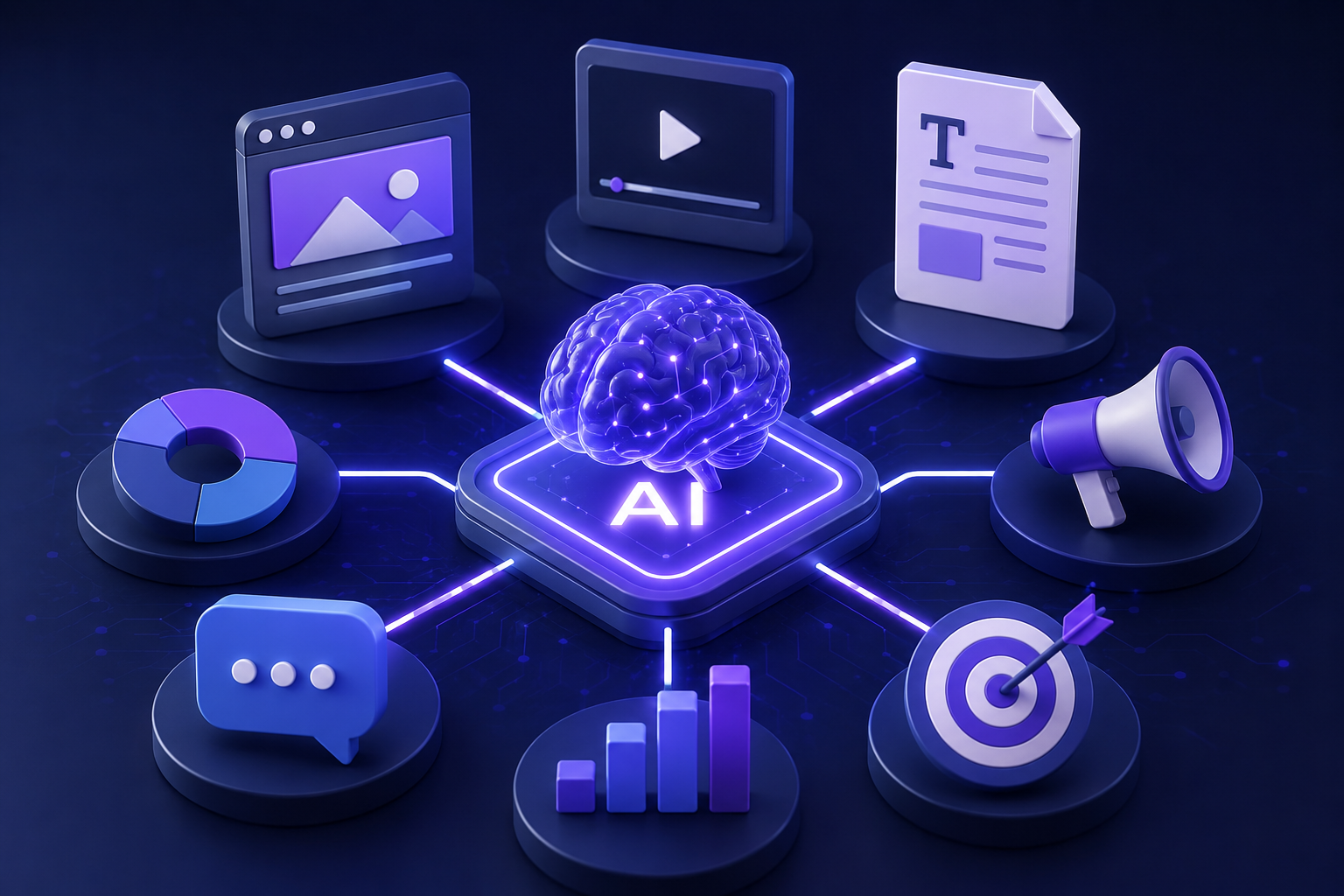
Consistency and value in content become more challenging for growing companies. From humble beginnings with a handful of blog articles, social media updates, and email marketing campaigns, many businesses find that their content needs skyrocket as their audience expands. This can be assisted by content marketing frameworks powered by AI. Organization of content strategy, production, distribution, and improvement can be facilitated by these frameworks for businesses. A lot of tedious jobs can be made easier with AI. Help with content development, topic recommendations, audience interest estimation, workflow optimization, and idea generation are all within its capabilities.
Although they don’t depend on it totally, successful brands do use technology. They merge human imagination with AI assistance. Teams can keep things organized and consistent with an AI content marketing plan. Additionally, it liberates marketers from mundane duties, enabling them to concentrate on formulating strategies and engaging with audiences. As competition in the digital space heats up, companies that stick to a defined framework will have an easier time producing engaging content that grows audience trust and devotion to their brand.
The Importance of Structured Content for Scalable Brands
Companies find it challenging to increase content production without proper organization. While content publishing may yield initial success, expanding operations presents distinct obstacles. Businesses need to better integrate their products, customer segments, and promotional avenues. When content isn’t organized, it runs the risk of being irrelevant to corporate objectives, inconsistent, or repetitive. The goals of the brand may be met at every stage of content generation with the help of an AI-driven content marketing strategy and a roadmap.
Companies can achieve long-term success by consistently following a strategy instead of winging it when it comes to publishing content. Opportunities for content, insights into target audiences, and huge data can be uncovered with the use of AI. As a result, preparation is made easier and more manageable. When roles are defined and responsibilities are clear, teamwork increases. Editors, marketers, and managers are all able to work together more effectively when they have well-defined objectives and procedures to follow. As a result, businesses may produce more material without lowering standards for quality or reach. To scale up, you need more output and more audience engagement, so finding that sweet spot is essential.
Building an AI-Driven Content Marketing Framework
Every good structure requires a solid foundation. Brands must understand their target audience, objectives, and content priorities before deploying AI. Identifying the target audience is the guiding principle for all subsequent decisions. AI systems perform best with clear instructions and reliable data. Brands with a clearly defined target audience generally achieve better content results. The basic phase involves identifying content themes that reflect the brand’s expertise and values.
Future content creation will revolve around these principles. Artificial intelligence can suggest themes, analyze patterns, and organize material into concrete solutions. Content standards are another crucial element. Consistency in tone, style, and message delivery builds trust over time. While AI can assist with content creation, its accuracy and authenticity ultimately require human verification. A solid foundation helps companies scale efficiently. Without this foundation, even the most advanced technology cannot succeed in creating meaningful results that resonate with the target audience.
Leveraging AI for Content Research and Planning
The research and preparation phase of content marketing is often time-consuming. Identifying audience interests, gathering research data, and selecting topics can be quite challenging. Artificial intelligence (AI) can streamline this process by rapidly processing massive amounts of data. Modern technology can reveal trends in audience behavior, popular search terms, and content gaps that humans would otherwise overlook. Marketers can use this data to better plan content.
Teams can focus on audience-relevant concepts, making planning more efficient. AI can also create content calendars and recommend topics relevant to content themes. Brands can create content ecosystems that guide readers through multiple interactive phases, rather than offering isolated pieces of content. This can standardize the audience experience and improve business processes. Effective planning ensures that every piece of content has a clear purpose and supports brand goals. By strategically deploying AI in the research and planning phase, brands can shorten brainstorming time and focus more on developing practical content.
Leveraging AI to Create High-quality Content
Content creation is a crucial part of any marketing plan. In this phase, AI can create outlines and concepts, improve readability, and accelerate the editing process. Successful companies understand that AI can complement human innovation. Authentic experiences, relevant concepts, and sincere communication appeal to readers. AI can accelerate content creation, but humans give content personality, context, and uniqueness. A successful AI content marketing architecture fosters human-machine collaboration.
AI-generated creative ideas can help writers align content with the brand tone. This approach typically improves efficiency without compromising quality. AI technology can monitor style guidelines and content standards, simplifying the maintenance of content consistency. As companies grow, it becomes critical to uphold quality amidst vast volumes of content. Companies can combine efficiency with human control to create useful, engaging, and relevant content that aligns with audience needs.
Content Distribution and Performance Improvement
Excellent content creation is just the beginning. Brands need effective distribution channels to create value. AI content marketing platforms enable consistent content distribution across all channels. AI can suggest content distribution, measure audience engagement across all channels, and recommend publication times. Marketers can use this data to better determine where and how they publish content. Performance analysis is crucial because it reveals audience preferences and areas for improvement.
AI can analyze massive datasets and generate valuable insights. This data can help brands optimize their content strategies. Because audience preferences and the market environment are constantly changing, scaling requires continuous improvement. Companies can maintain their growth momentum by adjusting their strategies through ongoing analysis and optimization. When content creation, distribution, and performance evaluation are integrated, companies can increase audience engagement and achieve sustainable growth.
Conclusion
AI content marketing frameworks provide a structured way for brands to manage growth while maintaining content quality and consistency. By combining strategic planning, audience understanding, AI-powered research, human creativity, and continuous improvement, businesses can create scalable content systems that support long-term success. The goal is not to replace people with technology but to use technology as a tool that enhances productivity and decision-making. Brands that build strong frameworks today are better positioned to meet future content demands and continue delivering value to their audiences.
FAQs
1. What is an AI content marketing framework?
An AI content marketing framework is a structured process that uses artificial intelligence tools to support content planning, creation, distribution, and performance analysis.
2. Can AI create all content without human involvement?
AI can assist with content creation, but human oversight is important for maintaining accuracy, authenticity, and brand voice.
3. Why is a content framework important for growing brands?
A framework helps maintain consistency, improves workflow efficiency, and ensures content supports larger business goals as the brand expands.
4. How does AI help with content planning?
AI can analyze audience behavior, identify content opportunities, suggest topics, and help organize content calendars.
5. Is AI content marketing suitable for small businesses?
Yes, small businesses can benefit from AI tools because they help save time, improve organization, and support content production with limited resources.