
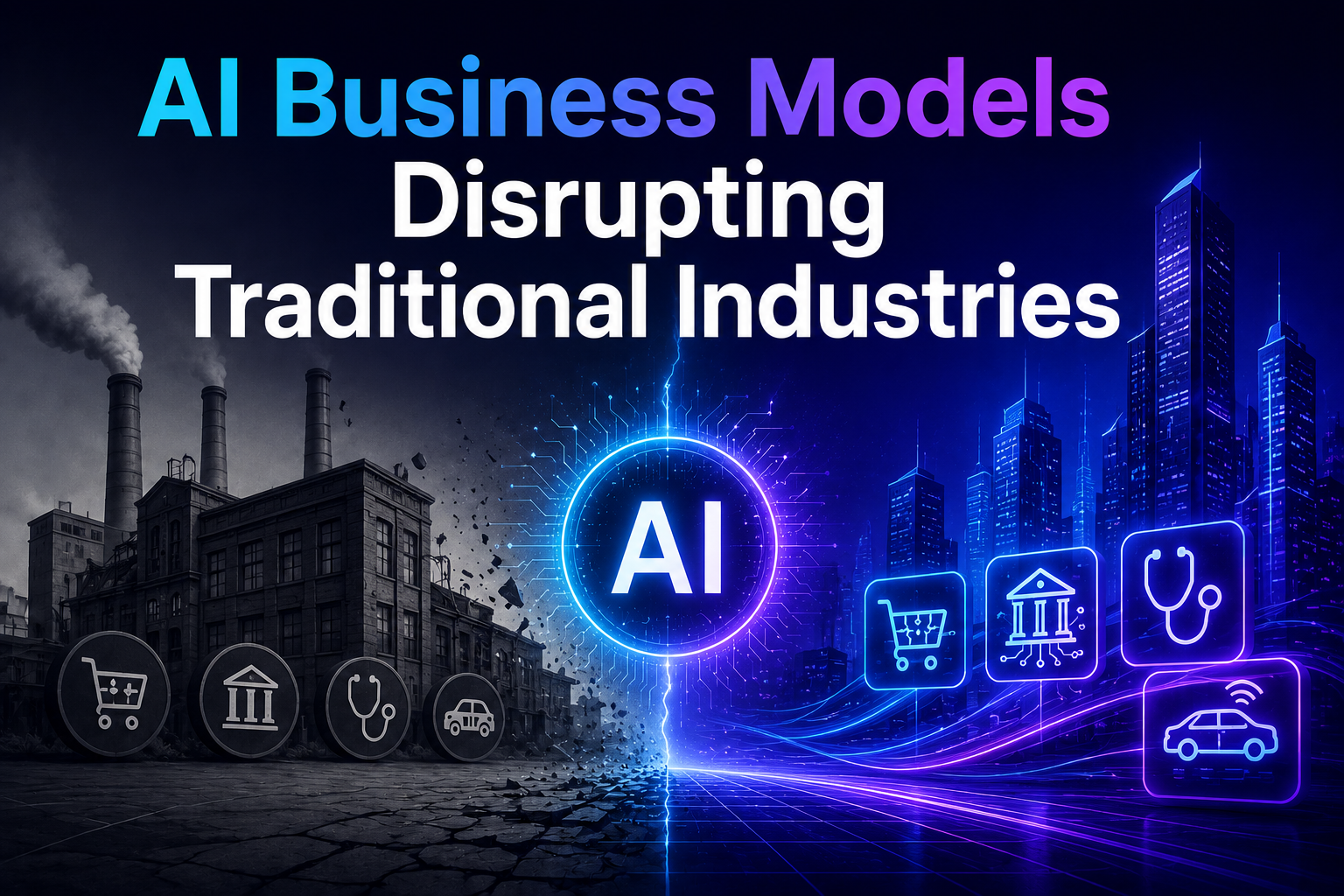
Over the course of four decades, my grandpa managed a hardware store. Allow me to place it. The same vendors. His familiar face brought back the same customers. The local nature of trust, the scarcity of information, and the fact that there were only two other hardware stores in town all contributed to the success of that business model. Such a shop would face stiff competition from the likes of Amazon, inventory systems driven by artificial intelligence, algorithms that dynamically adjust prices, and chatbots that respond to customers’ queries at 2 in the morning. Yes, the old model is having trouble. New business models that didn’t exist ten years ago are slowly destroying it.
This is occurring in all conventional industries. Not in the near future. Right now. Entrepreneurs that grasp the new AI business models face competition from more than just established companies. They are being replaced. This article takes a look at how six different industries have been affected by disruption. This is not an academic study; rather, it is an examination of the real-world dynamics at play, including the flow of capital, the areas where established businesses are losing money, and the opportunities presented by AI-native startups.
The Anatomy of AI Disruption
Before examining specific industries, let me explain the pattern that repeats everywhere. Traditional businesses operate on three assumptions that AI business models destroy:
- Assumption One: Expertise is scarce and expensive. Traditional law firms charge $400 per hour because legal expertise requires years of training. AI legal platforms charge $49 per month because they can analyze thousands of cases instantly and generate documents that used to require associates.
- Assumption Two: Scale requires proportional resources. Traditional schools need more teachers for more students. AI tutoring platforms serve 100,000 students with the same core system, personalizing instruction for each one without hiring 100,000 teachers.
- Assumption Three: Information asymmetry creates profit. Traditional real estate agents profit because buyers and sellers do not have access to the same data. AI real estate platforms democratize pricing data, market trends, and negotiation analytics, collapsing the information gap that agents used to monetize.
Every AI disruption follows this pattern. Identify the assumption. Build a model that violates it. Capture the value that leaks out.
Industry 1: Healthcare — From Reactive to Predictive
What Traditional Healthcare Looks Like
You get sick. You call a doctor. You wait two weeks. You spend 15 minutes in an exam room. The doctor guesses based on symptoms and prescribes something. You pay $200. If it does not work, you repeat the cycle. This model is reactive, expensive, and built on the scarcity of medical expertise. It works for the providers. It barely works for the patients.
How AI Is Rewriting the Model
AI-powered diagnostics: Platforms like K Health and Babylon Health use AI to triage symptoms, suggest diagnoses, and recommend treatments before a human doctor is involved. The AI has been trained on millions of cases. It is not replacing doctors for serious conditions. It is handling 70% of routine cases, freeing doctors for complex care and reducing costs by 60%.
Predictive health monitoring: Wearables and AI analytics predict health issues before symptoms appear. A diabetic patient’s glucose patterns trigger alerts before a crisis. A heart patient’s rhythm data flags arrhythmias days before they become dangerous. The model shifts from “treat when sick” to “prevent before you get sick.”
AI drug discovery: Traditional pharmaceutical companies spend $2.6 billion and 10 years to bring a drug to market. AI platforms like Atomwise and Insilico Medicine find drug candidates in months, not years, by simulating molecular interactions at speeds that physical labs cannot match.
The New Business Model
| Traditional Model | AI-Native Model | Who Wins |
|---|---|---|
| Fee-for-service per visit | Subscription for continuous monitoring and prevention | Patients save money. AI platforms capture recurring revenue. |
| Expert diagnosis by human only | AI triage + human confirmation for complex cases | Patients get faster answers. Doctors handle higher-value work. |
| Pharma companies own discoveries. | AI platforms license discovery capabilities to pharma | AI platforms get licensing fees. Pharma reduces R&D costs. |
| Insurance pays for treatment | Insurance pays for prevention (lower long-term costs) | Insurers reduce payouts. Patients stay healthier. |
Industry 2: Financial Services — From Gatekeepers to Enablers
What Traditional Finance Looks Like
Banks decide who gets loans based on credit scores and human judgment. Wealth managers charge 1% annually to pick stocks that mostly track the market. Insurance underwriters assess risk using decades-old actuarial tables. The entire industry controls access to capital and information.
How AI Is Rewriting the Model
AI-powered lending: Platforms like Upstart and Kabbage use AI to analyze thousands of data points beyond credit scores—employment history, education, cash flow patterns, and even behavioral data—to assess creditworthiness. They approve loans that traditional banks would reject and reject loans that traditional banks would approve. Default rates are lower. Approval rates are higher.
Robo-advisors with intelligence: Early robo-advisors simply allocated money across index funds. New AI-powered platforms analyze market sentiment, macroeconomic signals, and individual risk tolerance to dynamically adjust portfolios. They are not just cheaper than human advisors. Often, they are performing better.
AI insurance underwriting: Traditional insurers use broad categories: “male, age 35, non-smoker.” AI insurers use granular data: driving behavior from telematics, health data from wearables, and property data from satellite imagery. Pricing becomes personalized. Risk assessment becomes precise. Profitable customers get better rates. Unprofitable ones are priced accurately or declined.
The New Business Model
The shift is from “we control access to financial services” to “we use AI to democratize financial intelligence.” The profit moves from transaction fees and management charges to data monetization, platform subscriptions, and value-added services built on AI insights.
A traditional bank makes money on the spread between deposit and loan rates. An AI-native financial platform makes money on the insights it generates from analyzing financial behavior — insights that help users save more, invest smarter, and borrow responsibly. The customer wins. The platform wins. The traditional bank that refused to adapt loses.
Industry 3: Real Estate — From Brokers to Platforms
What Traditional Real Estate Looks Like
Selling a house means hiring an agent who takes 6% commission. Buying a house means relying on that agent’s limited knowledge of local inventory. The entire transaction is slow, expensive, and built on information that the agent controls but the consumer does not.
How AI Is Rewriting the Model
- AI-powered valuation: Platforms like Zillow’s Zestimate and HouseCanary use AI to analyze millions of data points—recent sales, neighborhood trends, school ratings, economic indicators, and even satellite imagery of property conditions—to generate instant, accurate home valuations. The buyer and seller both know the fair price before negotiations begin.
- AI matching and search: Traditional agents show buyers properties they happen to know about. AI platforms analyze buyer preferences, behavior, and lifestyle data to match them with properties they would never have found otherwise. The search is not just faster. It is smarter.
- AI transaction management: The paperwork, scheduling, and coordination of a real estate transaction involve dozens of steps and multiple parties. AI platforms automate document generation, schedule inspections, track deadlines, and flag issues before they become deal-killers. Transactions close faster with fewer surprises.
The New Business Model
| Traditional Element | AI Replacement | Cost Impact |
|---|---|---|
| 6% agent commission | 1% to 2.5% platform fee + AI tools | Sellers save $10K-$20K on a $400K home |
| Manual property search | AI-powered matching with 95% relevance accuracy | Buyers find homes 3x faster |
| Human appraisal ($500-$800) | Instant AI valuation (free or $29) | 97% cost reduction |
| Paper-based closing (45-60 days) | AI-managed closing (14-21 days) | Time savings worth thousands in carrying costs |
Industry 4: Education — From Standardized to Personalized
What Traditional Education Looks Like
Thirty students sit in a classroom. One teacher delivers the same lesson at the same pace to everyone. Some students are bored because they already understand. Some are lost because they missed a prerequisite concept. The system is designed for efficiency, not learning. It is a factory model applied to human minds.
How AI Is Rewriting the Model
- Adaptive learning platforms: AI tutoring systems like Khan Academy’s Khanmigo and Carnegie Learning’s MATHia adjust difficulty, pacing, and teaching style in real time based on each student’s performance. A student who masters algebra in three hours moves on. A student who needs twelve hours gets those twelve hours. No one is left behind. No one is held back.
- AI-generated curriculum: Teachers spend 50% of their time on administrative tasks—grading, lesson planning, and material creation. AI handles all of it. Teachers focus on mentorship, motivation, and the human connection that AI cannot replicate. The model shifts from “teacher as information deliverer” to “teacher as learning facilitator.”
- Skills-based credentialing: Traditional education sells degrees. AI-powered platforms sell demonstrated competence. A student completes AI-assessed projects, builds a portfolio verified by AI analysis, and receives credentials that employers trust because they are based on actual capability, not classroom attendance.
The New Business Model
Education is shifting from “pay for time in a classroom” to “pay for demonstrated mastery.” AI platforms charge per skill mastered, not per semester enrolled. Employers subscribe to platforms that verify candidate skills with AI assessment. Students pay for outcomes, not access. The institutions that cling to the old model become increasingly irrelevant as employers and learners discover that mastery matters more than pedigree.
Industry 5: Legal Services — From Billable Hours to Fixed Outcomes
What Traditional Legal Services Look Like
Lawyers bill by the hour, which means they profit from complexity and delay. A simple contract review takes three hours because every paragraph must be analyzed manually. A straightforward divorce can take months, as every document must be drafted from scratch. The incentive structure rewards slowness.
How AI Is Rewriting the Model
- AI document generation: Platforms like LegalZoom and Rocket Lawyer use AI to generate contracts, wills, incorporation documents, and legal filings from templates and user inputs. What used to cost $1,500 and two weeks now costs $99 and ten minutes. The quality is not lower. It is often higher because AI does not miss standard clauses or make typos.
- AI contract analysis: Tools like Ironclad and Kira Systems read thousands of pages of contracts in minutes, identifying risks, obligations, and inconsistencies that human lawyers would take days to find. Due diligence for mergers and acquisitions that used to require teams of associates now requires one senior lawyer and an AI platform.
- AI litigation support: Discovery — the process of reviewing millions of documents to find relevant evidence — used to be the most expensive part of litigation. AI platforms analyze documents, emails, and communications in hours, identifying relevant materials with higher accuracy than human reviewers. Cases settle faster because both sides know the evidence sooner.
The New Business Model
Legal services are shifting from “pay for my time” to “pay for the outcome.” AI platforms charge fixed fees for specific deliverables: $49 for a will, $199 for an LLC formation, and $999 for a contract review. Customers know exactly what they are paying for. Lawyers who adopt AI tools can handle 5x more clients at lower prices while maintaining profitability. The ones who refuse are priced out of the market for routine work and forced to compete only for high-stakes litigation where human judgment remains essential.
Industry 6: Manufacturing — From Mass Production to Mass Customization
What Traditional Manufacturing Looks Like
Factories produce thousands of identical units. Quality control samples a small percentage. Supply chains are managed by spreadsheets and phone calls. Downtime is accepted as inevitable. The model is optimized for scale, not for responsiveness or precision.
How AI Is Rewriting the Model
- Predictive maintenance: AI sensors monitor equipment vibration, temperature, and performance patterns. They predict failures before they happen, scheduling maintenance during planned downtime instead of emergency shutdowns. One automotive manufacturer reduced unplanned downtime by 40% using AI predictive maintenance, saving $2 million annually per factory.
- AI quality control: Computer vision systems inspect every unit, not just samples. They detect defects invisible to human eyes — micro-cracks, color variations, dimensional inconsistencies — at speeds no human inspector can match. Defect rates drop. Customer returns drop. Brand reputation rises.
- Demand-driven production: AI analyzes real-time sales data, social trends, and economic signals to adjust production schedules dynamically. Instead of producing 10,000 units and hoping they sell, manufacturers produce what is selling now and pivot instantly when demand shifts. Inventory costs plummet. Waste disappears.
- Mass customization: AI-driven production lines can switch between product configurations instantly. A customer orders a custom-configured product online. The AI sends instructions to the factory floor. The product is built to spec without human intervention. The cost approaches mass production pricing while the value approaches bespoke craftsmanship.
How to Spot the Next AI Disruption Opportunity
If you want to build or invest in AI business models that disrupt traditional industries, you need to recognize the signals before they become obvious. Here is what to look for:
Signal 1: High friction in a routine process. If a task requires multiple human touchpoints, long wait times, and significant cost for a standard outcome, AI can probably eliminate 80% of that friction. Insurance claims processing. Mortgage applications. Tax preparation. All are being disrupted because the friction was unnecessary.
Signal 2: Information hoarding as a profit model. Any industry where middlemen profit because they know something customers do not is vulnerable. Real estate agents knew market prices. Stockbrokers knew which stocks to recommend. Travel agents knew flight schedules. AI democratizes that information and collapses the middleman margin.
Signal 3: Expertise applied to repetitive decisions. When highly trained professionals spend most of their time on routine judgments rather than complex problem-solving, AI is coming for that routine. Radiologists reading standard X-rays. Paralegals reviewing standard contracts. Accountants process standard tax returns. The expertise is real. The repetition is automatable.
Signal 4: Customer pain that incumbents ignore. Traditional players often become complacent and stop listening to customer complaints. Long wait times. Hidden fees. Poor communication. AI-native competitors enter by solving these ignored pains first, then expand to capture the entire market.
Signal 5: Regulatory protection without innovation. Some industries face regulatory barriers that make entry difficult. But regulation does not protect against better service at lower prices. When AI can deliver regulated services with higher compliance and lower cost, the regulatory wall becomes a speed bump, not a barrier.
Building an AI Disruption Business: The Framework
If you want to create an AI business model that disrupts a traditional industry, follow this framework:
| Step | Action | Key Question |
|---|---|---|
| 1. Identify the assumption | Find the core belief that traditional players operate on | What do incumbents believe that AI proves wrong? |
| 2. Map the value chain | Trace where money flows and where friction exists | Where is value being captured without value being created? |
| 3. Design the AI-native model | Create a model that violates the traditional assumption | How would this industry work if AI handled the routine? |
| 4. Validate with early adopters | Find customers frustrated enough to try something new | Who is already complaining about the traditional experience? |
| 5. Scale with network effects | Build features where each new user makes the product better | How does AI improve as more people use it? |
Final Thoughts
My grandfather’s hardware store closed in 2019. It was not because he was a bad businessman. He was excellent. It closed because the assumptions his business was built on—local trust, information scarcity, and limited competition—no longer held in a world where AI makes expertise instant, information free, and competition global.
The industries examined in this article are not special cases. They are previews. Every industry that operates on outdated assumptions about expertise, scale, and information control will face the same disruption. The question is not whether AI will reshape your industry. It is whether you will be among those doing the reshaping or among those being reshaped.
The entrepreneurs who build the future are not waiting for permission. They are identifying the assumption, building the model that violates it, and capturing the value that leaks out. That is the game. And it is happening right now, in every industry, all around you. Which traditional industry do you think is most vulnerable to AI disruption right now? Share your thoughts in the comments. I read everyone.
Sources and References
- McKinsey & Company. “The State of AI in 2025: Generative AI’s Breakout Year.” 2025. https://www.mckinsey.com/capabilities/quantumblack/our-insights/the-state-of-ai-in-2025-generative-ais-breakout-year
- Harvard Business Review. “How AI Is Disrupting Traditional Industries.” 2025. https://hbr.org/2025/04/how-ai-disrupts-traditional-industries
- Forbes. “The Industries Being Transformed by AI Business Models.” 2025. https://www.forbes.com/sites/bernardmarr/2025/05/20/ai-industries-transformed/
- Statista. “Global Artificial Intelligence Market Revenue from 2020 to 2030.” 2026. https://www.statista.com/statistics/941935/artificial-intelligence-market-revenue-worldwide/
- TechCrunch. “AI Startups Disrupting Healthcare, Finance, and Real Estate.” 2025. https://techcrunch.com/2025/09/01/ai-startups-disrupting-industries/